Expansion Defined Relativity (EDR):
A Conceptual Framework for Time, Gravity, and Cosmic Structure
Author: David Suttle
Email: [email protected]
Abstract
Expansion-Defined Relativity (EDR) is a conceptual framework built around a single physical principle: the continual generation of space sets the local rate of time. Mass-energy suppresses expansion, causing different regions of the universe to evolve at different rates. These differences create gradients in both time rate and Realised Spatial Extent, from which gravitational behaviour naturally emerges.
EDR is constructed to harmonise with General Relativity [1], rather than replace it. GR describes the geometric behaviour of spacetime in the presence of mass-energy. EDR seeks to explain the physical mechanism that gives rise to that behaviour, proposing that gravity emerges from differential expansion, while associated changes in time rate and Realised Spatial Extent produce the curvature-like effects conventionally described geometrically by General Relativity.
The framework provides a unified physical picture linking time, gravity, cosmic structure, and cosmological evolution through a common underlying process. From this perspective, phenomena such as gravitational time dilation, black hole horizons, large-scale structure formation, and cosmic acceleration arise as natural consequences of differential spatial expansion operating across environments of differing density.
The purpose of this paper is to establish the conceptual foundations of EDR, define the physical boundary conditions that any future mathematical formulation must satisfy, and present a candidate master equation for further development.
1 Introduction
The purpose of this paper is to articulate the principles of Expansion Defined Relativity (EDR), explore its physical consequences, and define the boundary conditions that any future mathematical formulation must satisfy. The focus throughout is on the internal logic of EDR itself rather than on comparisons with existing models.
Spatial expansion [2] is a physical process, the local strength of which determines how fast time runs. Where mass-energy suppresses expansion, the time rate slows; where expansion is unhindered, the time rate is faster. Variations in expansion shape clocks, lengths, trajectories, and cosmic evolution. Differences in expansion also shape the environment through which objects move, creating an emergent geometry that arises from expansion itself.
Foundational Axioms (the minimal assumptions EDR requires):
-
Expansion is a monotonic intrinsic physical property of space.
-
Mass-energy suppresses expansion.
-
The local rate of expansion sets the local rate of time; expansion and time rate are inseparable - they are two sides of the same coin.
Immediate Consequences (what follows directly from the axioms):
-
Gravity emerges from differential expansion; time rate differences and the resulting Length Deficit reproduce General Relativity (GR) like behaviour in the weak-suppression limit [1].
-
Expansion produces an outward pressure; this repulsive component is masked inside bound systems and absorbed into inferred values of mass and \(G\).
-
All physical processes inherit the local expansion-defined time rate; motion, light frequencies, and quantum phase evolution follow the local rate of expansion.
Think of expansion as the local “heartbeat” of space: clocks slow where mass suppresses this heartbeat, and clocks run faster where expansion is free. Because the time rate is tied directly to expansion, which in turn drives a Length Deficit, EDR provides a unified picture of gravitational time rate slowing, black hole horizons, cosmic acceleration, and the large-scale structure of the universe.
EDR is not an alternative to Einsteinian General Relativity, but an explanatory layer beneath it. General Relativity is a highly successful geometric description of a four-dimensional spacetime manifold, describing how matter and curvature interact. EDR seeks to explain why this curvature occurs, reframing coordinate warping as the emergent consequence of local variations in the geometry of a spatial substrate.
2 Foundations of Expansion-Defined Relativity
2.1 Expansion as a Physical Quantity
Space expands through the continual generation of new spatial substrate [2]. This continual production of new space defines expansion and sets both lengths and local time rates: regions with higher mass-energy density suppress expansion and exhibit a spatial deficit, while emptier regions evolve more quickly and contain more spatial volume. Only the relative differences in expansion matter; EDR is concerned with relationships between neighbouring regions rather than any absolute background.
2.2 Proper Time
Any physical clock - atomic, quantum, or mechanical - ticks at the pace dictated by the local expansion rate, providing an operational definition of Proper Time. Elapsed time is simply accumulated Proper Time. Because all physical processes run at this local rate, each region experiences its own physics as perfectly normal and self-consistent.
2.3 Realised Spatial Extent
The continual generation of new spatial substrate results in different realised separation associated with different regions of space. Realised Spatial Extent depends on the local expansion history: regions with stronger expansion possess greater accumulated spatial extent, while regions with suppressed expansion possess less.
3 Emergent Physical Consequences
3.1 Spatial Extent
3.1.1 Length Deficit
Length Deficits emerge where regions that expand more slowly accumulate less new spatial substrate over time. When two regions with different expansion histories are compared, distances within the slower region are correspondingly shorter. Length Deficit therefore emerges naturally in regions that have experienced slower expansion, and the resulting difference in Realised Spatial Extent forms part of the overall geometric structure of space.
3.1.2 Emergent Gravity
Gravity emerges in proximity to mass-energy. The resulting suppressed expansion drives Length Deficits and slows Proper Time Rates. Objects naturally follow paths that minimise realised distance and elapsed Proper Time within the geometry that expansion has shaped.
Proper Time Rate differences provide the immediate expression of suppressed expansion, while Length Deficit represents its accumulated spatial consequence. Together these manifestations of the same underlying process give rise to the geometric behaviour associated with gravitational motion and naturally reproduce the gravitational behaviour predicted by General Relativity [1].
3.1.3 Emergent Gravity Consequences
The immediate and accumulated consequences of Expansion Suppression act together to shape the evolving geometry experienced by matter and radiation. The slowing of the local Proper Time Rate provides the immediate manifestation of suppression, while Length Deficit represents its accumulated geometric consequence. Together these effects produce the curvature-equivalent behaviour from which gravity emerges.
Realised Spatial Extent forms part of the evolving geometry of the universe and evolves causally as suppression patterns change. The effective gravitational contribution associated with Length Deficit therefore depends on the historical stability of the local suppression environment. Regions where suppression patterns remain stable for extended periods exhibit the full accumulated geometric effect, while regions experiencing rapid change exhibit a correspondingly evolving contribution.
This distinction is important because present-day gravitational behaviour reflects not only current suppression conditions, but also the accumulated expansion history that shaped the local geometry. Gravity in EDR therefore contains both an immediate component arising from local suppression and an accumulated component arising from realised spatial geometric structure.
3.1.4 Masking of Expansion Effects in Mass and Gravitational Constant Measurements
EDR adds one further effect: spatial expansion produces an outward pressure. This pressure is stronger in regions where expansion is less suppressed (e.g. in proximity to spatial voids). In dense regions, where expansion is heavily suppressed, the outward pressure is minimal. In bound systems like the Solar System, this outward pressure is absorbed into current orbital mass estimates, making it observationally invisible. It is nevertheless important, as it underlies several large-scale phenomena discussed later.
In bound systems, both the inward pull and outbound expansion pressure decrease with distance according to the same inverse-square law, so the outward component is absorbed into the net attraction. Orbital measurements therefore absorb this outward pressure into the inferred values of \(M\) and \(G\), making the locally measured values effective quantities that already include the compensating term.
This masking breaks only in the presence of a strong external Expansion Gradient. The Solar System provides such a case: its ~60° tilt relative to the Milky Way disc, combined with its position ~20–30 light-years above the galactic mid-plane, places it across a persistent gradient between the dense galactic interior and the surrounding intergalactic medium, producing a small directional acceleration that cannot be cancelled internally.
Historical astrometric anomalies [9], [10], [11] are consistent with this external gradient perturbing the otherwise hidden masking loop. This includes the secular increase of the astronomical unit, the slow growth of the Moon’s orbital eccentricity, and velocity shifts during spacecraft gravity assists.
3.1.5 Refractive Gravity, Light Bending, and GR Equivalent Geodesics
Because EDR reproduces the same curvature-equivalent behaviour that GR attributes to curved spacetime, light follows the same geodesic paths in both frameworks. The bending of light near mass is therefore observationally identical.
When light passes through a region where expansion is suppressed, both the local Proper Time Rate and the realised spatial geometry are altered. Light therefore follows the path of least accumulated time and distance through the resulting expansion-defined environment.
For null paths, the immediate and accumulated consequences of suppression contribute with comparable weight. This naturally produces the familiar 50:50 division between temporal and spatial contributions that appears in GR's description of light deflection. EDR does not impose this ratio; it emerges because both effects arise from the same underlying suppression structure and therefore align in scale within stable environments.
The result is the same deflection measured by Eddington [4]. Gravitational lensing, Shapiro delay, and other null-path phenomena emerge naturally from the combined influence of time-rate suppression and realised spatial geometry. In EDR, the path of light reflects the geometry and time-rate structure created by Expansion Gradients, providing behaviour that is observationally equivalent to the curved-spacetime description of General Relativity.
3.1.6 Gravitational Advantage
Gravity emerges from the geometric effects of differential expansion and depends on gradients rather than absolute suppression alone. A given local suppression has a different significance depending on the surrounding expansion environment.
Gravitational Advantage is used as a conceptual descriptor of gravitational effectiveness rather than a directly measurable physical quantity.
Gravitational Advantage arises from the combined action of several reinforcing effects:
-
Void driven matter concentration: Expanding voids actively displace matter into surrounding over-densities, accelerating differentiation and structure formation in a self-reinforcing feedback loop. Because gravity in EDR emerges from Expansion Gradients, the physical scale of a void directly influences the steepness of the gradients it generates. Smaller voids compress the transition between under-dense and over-dense regions into shorter distances, producing steeper local geometries than larger voids. As average matter density increases, characteristic void sizes decrease, naturally increasing the effectiveness of gravity. This effect was strongest when the first fully formed voids emerged but had yet to grow significantly, producing the steepest void-driven Expansion Gradients in cosmic history.
-
Enhanced fractional Expansion Gradients: Strong background suppression means small local variations represent large fractional departures from the surrounding expansion state, generating unusually steep gravitational gradients.
It may appear counterintuitive, but strong overall suppression does not weaken gravitational effects. Instead, it increases the significance of local variations. The same local reduction in expansion represents a much larger fractional departure from the surrounding state when the background expansion rate is already low.
A simple analogy is a shallow pond and a deep ocean. The same depression in water level represents a far larger disturbance in the pond than in the ocean. Likewise, the same local suppression is far more significant relative to the surrounding expansion state in the dense early universe than in the present-day.
In the dense early universe, where expansion was strongly suppressed everywhere, even modest local variations stood out sharply from their surroundings. In the present-day universe, the same variation represents a much smaller departure from the background environment. The underlying variation is unchanged, but its relative significance is greater in the denser environment, producing steeper effective gradients and increasing the effectiveness of gravity.
-
High density and short separations: Matter is physically closer together, making mass concentrations gravitationally more responsive.
Because expansion and time rate are inseparable in EDR, each of these mechanisms enhances both the geometric and the associated time rate gradients from which gravity emerges. The resulting geometric and temporal effects therefore reinforce one another, further increasing the effectiveness of gravitational organisation in high-density environments.
Together, these effects make gravity increasingly effective as background mass-energy density rises. Small variations are amplified rapidly, allowing matter to differentiate into increasingly complex structures.
Gravitational Advantage acts as a powerful attractor toward structure formation. In high-density environments, matter differentiates and organises more efficiently. Its influence is strongest during the earliest high-density phases of cosmic evolution and diminishes as average density falls.
3.1.7 Differentiation Potential
Gravitational Advantage describes the effectiveness of gravitational organisation within a given environment. However, organisation alone is insufficient to generate complex structure if little differentiated structure exists to organise.
EDR therefore distinguishes between two related concepts:
Gravitational Advantage: the environmental effectiveness of gravitational organisation.
Differentiation Potential: the effectiveness with which Gravitational Advantage can generate and amplify structural differentiation.
Like Gravitational Advantage, Differentiation Potential is used as a conceptual descriptor rather than a directly measurable physical quantity.
Differentiation Potential depends upon both:
The strength of Gravitational Advantage.
The degree of existing differentiation within the surrounding environment.
A highly homogeneous universe may possess substantial Gravitational Advantage while exhibiting relatively low Differentiation Potential because only weak density contrasts are available for further organisation. Conversely, a highly differentiated environment with weak Gravitational Advantage may also exhibit limited development because the organisational influence has diminished.
Differentiation Potential is therefore greatest when both conditions are present simultaneously: strong Gravitational Advantage and substantial differentiation. In this sense, it provides a conceptual measure of how effectively complexity and structure can emerge within a given cosmological regime. This distinction separates the ability of an environment to organise matter from the availability of differentiated structure upon which that organisation can act.
It therefore follows that because Differentiation Potential depends upon both Gravitational Advantage and the existing degree of differentiation, it does not track either quantity independently. A highly homogeneous early-time environment possesses very strong Gravitational Advantage but little opportunity for further differentiation, while a highly differentiated later-time environment possesses comparatively weak Gravitational Advantage and therefore a reduced capacity to amplify further structure. Differentiation Potential is therefore greatest when both conditions are simultaneously significant.
3.2 Time
3.2.1 Time Emergence
In EDR, time is an emergent consequence of the fundamental expansion process. Time is not an independent backdrop against which the universe evolves. Rather, the progression of time is a direct consequence of spatial generation.
Spatial structure does not form as a result of processes occurring in time; time happens as a result of spatial structure forming.
A common intuition is that physical processes occur within time, and therefore require a sufficient quantity of time to be available before they can unfold. In EDR, this intuition is reversed. Time is not an independent backdrop within which physical change occurs. The expansion process and the accumulation of time are inseparable aspects of the same underlying phenomenon. Physical change does not consume pre-existing time; rather, the unfolding of physical change and the accumulation of time are different descriptions of the same process. The question is therefore not whether sufficient time existed for an event to occur, but how much time accumulated as that event unfolded.
3.2.2 Time Rates
EDR defines three distinct time rates, each associated with a different reference frame:
Unsuppressed Time Rate represents the theoretical maximum rate at which time can progress in a reference frame free from mass-energy suppression and serves as the baseline against which cosmological evolution is measured.
Cosmic Time Rate represents the universe-wide time rate established by the prevailing state of cosmic expansion at a given epoch.
Proper Time Rate represents the locally realised rate at which time progresses within a specific region of the universe and is the rate directly experienced by observers and physical systems.
3.2.3 Quantum Time
Quantum processes unfold according to Proper Time. Because Proper Time is defined by expansion, quantum frequencies and decay rates are not fundamental clocks but emerge from the local expansion rate itself. This places quantum evolution on the same underlying time-base as gravitational and cosmological processes.
3.2.4 The Arrow of Time
Expansion is intrinsically monotonic: new spatial fabric is created continuously and is never destroyed. Mass-energy can slow expansion locally, but nothing undoes it. Because expansion proceeds in only one direction, the rate of Proper Time inherits this one-way character. The arrow of time therefore arises directly and inevitably from the universe’s expansion.
3.3 Cosmic Structure
Differential expansion naturally drives the organisation of matter into increasingly distinct structures. Expanding voids accelerate the separation of emerging structures, while Gravitational Advantage amplifies this differentiation process in dense environments. Together these effects drive the development of the observed large-scale cosmic web.
3.4 Cosmic Acceleration
In the dense early universe, Gravitational Advantage and the emergence of the first voids greatly accelerated the differentiation of matter into increasingly distinct structures. As the universe expanded and average density fell, the influence of Gravitational Advantage diminished while growing voids increasingly came to dominate cosmic evolution.
In voids, density is lower, expansion is relatively unsuppressed, and the time rate correspondingly higher. As voids expand and eject matter, their density falls further, reducing suppression and accelerating expansion. This self-reinforcing feedback loop produces genuine physical acceleration.
By increasing the separation between regions of under-density and over-density, expanding voids reinforce and extend the differentiation that Gravitational Advantage had previously accelerated. Together, these complementary effects cause cosmic evolution to proceed far more rapidly than would otherwise be expected.
When measured from slower-running galactic clocks, this acceleration appears even stronger, creating the observed cosmic acceleration. More generally, differences in time rate between regions can create observational asymmetries when interpreted through a single assumed time rate.
4 Cosmological Evolution
Having described how differential expansion shapes local and apparent phenomena, we now turn to how the same generative process drives the universe’s long-term physical evolution.
4.1 The Genesis of Cosmic Evolution (z → ∞)
At its Genesis, the universe existed in an unimaginably dense, compact and uniform primordial state. In practical terms, the universe existed in an infinitesimal primordial configuration where Realised Spatial Extent, expansion rate and time rate were all correspondingly infinitesimal. Physical evolution therefore proceeded at an almost imperceptible pace, preserving the primordial state's remarkable uniformity over immense intervals of Unsuppressed Time.
From the perspective of a hypothetical external observer experiencing a reference frame running at the Unsuppressed Time Rate, no discrete beginning was required. The primordial state simply evolved at an infinitesimal pace.
The question is therefore not whether sufficient time existed for this evolution to occur, but how much Proper Time accumulated as the evolution unfolded.
The primordial state was not characterised by a complete absence of expansion, but by an infinitesimal expansion rate. As expansion strengthened imperceptibly, the Cosmic Time Rate strengthened with it, allowing increasingly complex physical processes to emerge. Initially, the Cosmic Time Rate would be effectively imperceptible from the perspective of the hypothetical external observer. Over immense spans of Unsuppressed Time, the universe slowly expanded out of its infinitesimal primordial state.
As expansion very slowly increased, the Cosmic Time Rate increased with it. Significant physical changes did not happen suddenly. They emerged gradually as expansion slowly strengthened.
As expansion accelerated, so too did the Proper Time Rate and hence the rate at which physical processes occurred. This led naturally to two complementary descriptions of cosmic origins.
-
From the perspective of the hypothetical external observer experiencing Unsuppressed Time, following an arbitrarily long period near unchanging homogeneity, the universe accelerated almost imperceptibly. The origin of the universe therefore appeared eternal rather than finite.
-
From the perspective of an observer inside the universe experiencing Proper Time however, tracing the clock backwards looked very different. As expansion gradually strengthened, Proper Time and associated physical interactions accumulated at an ever increasing rate. As measured using Proper Time, the universe had a finite, measurable internal age and what appeared as an eternity to the external observer contributed only a tiny amount of realised time within the universe itself.
The Big Bang was not a physical event marking the creation of the universe. It was the observational consequence of viewing an extremely slow and continuous process through clocks whose own rates were accelerating with the universe they were measuring. To internal observers, the infinitesimal primordial state appeared compressed into an apparent explosive beginning because the earliest stages of cosmic evolution contributed only a vanishingly small amount of accumulated Proper Time.
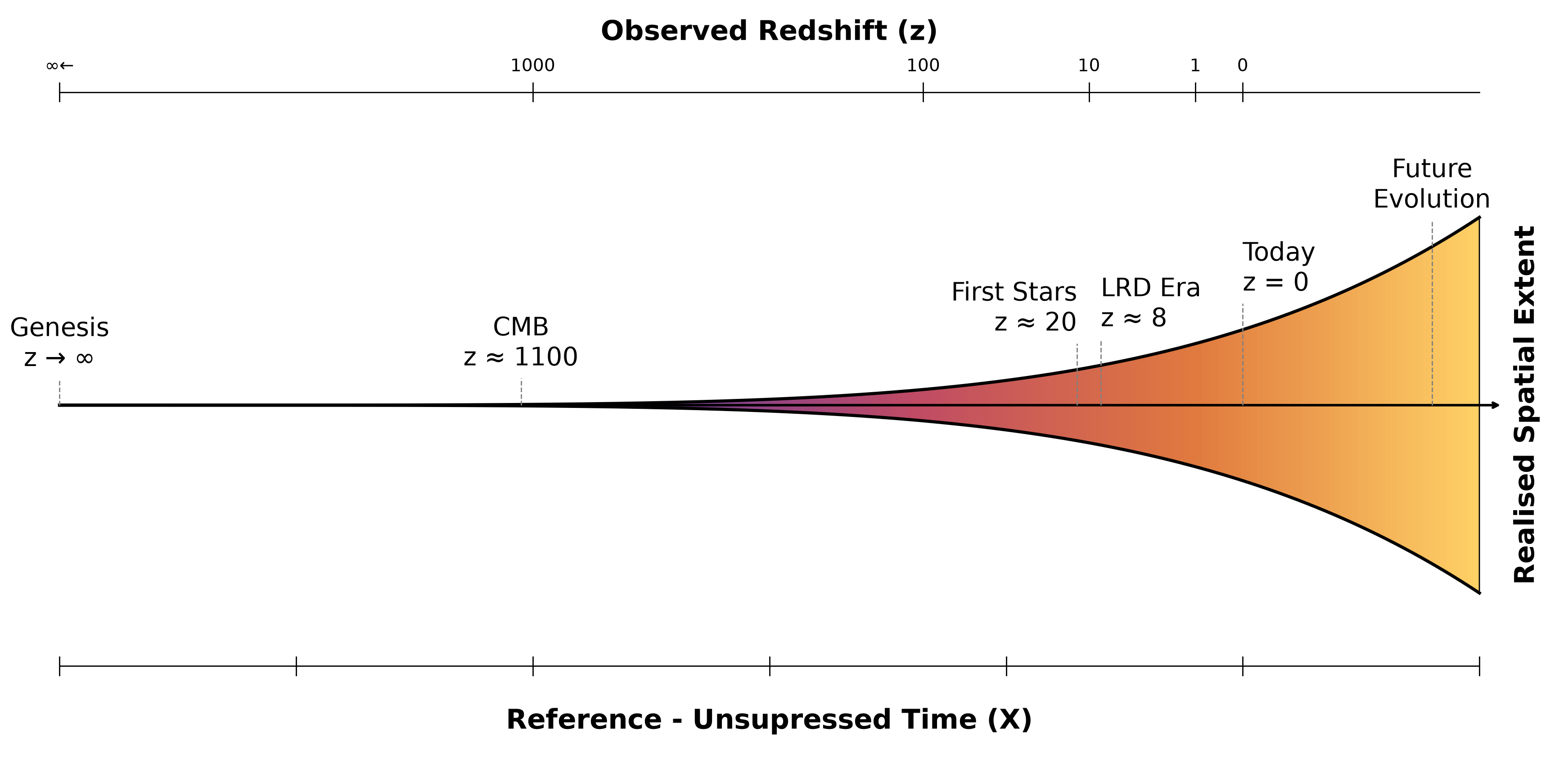
This relationship can be visualised using the EDR Trumpet shown in Figure 1. The horizontal axis represents elapsed Unsuppressed Time measured in the hypothetical external reference frame by a hypothetical external observer. The cross-sectional width of the trumpet represents the Realised Spatial Extent of the universe, while the slope of the trumpet wall represents the Cosmic Time Rate at which time progresses in any given epoch. The trumpet therefore provides a visual representation of the relationship between Unsuppressed Time Rate, Cosmic Time Rate, and Proper Time Rate.
This model requires that the early universe was inherently and perfectly uniform. Because spatial substrate generation and the Proper Time Rate advanced in a strict 1:1 lockstep, the pristine homogeneity of the primordial state was naturally maintained as the global generation rate accelerated away from rest. No additional smoothing mechanism was required because the primordial universe was inherently uniform. Structure appeared later as a natural consequence of differential expansion.
Near Genesis, the time rate and expansion are infinitesimal, and physical processes are therefore almost entirely suppressed, preserving the primordial state's uniformity.
Near Genesis, the trumpet narrows towards infinitesimal width and its walls become increasingly flat. This reflects a universe where spatial extent, expansion rate and time rate are infinitesimal. Progressing along the trumpet towards the present day, expansion gradually strengthens, increasing both the size of the universe and the rate at which physical processes can occur.
The trumpet illustrates how immense intervals of Unsuppressed Time can correspond to very little accumulated Proper Time. The long, narrow stem represents immense intervals of Unsuppressed Time during which the Cosmic Time Rate remains infinitesimal and only tiny amounts of Proper Time accumulate. As expansion strengthens, the Cosmic Time Rate accelerates, allowing increasingly complex physical processes to emerge. What appears from within the universe as a sudden beginning is therefore revealed as the compressed view of an immensely gradual transition. The apparent paradox of a universe that is both finite and eternal dissolves once the distinction between Unsuppressed Time, Cosmic Time , and Proper Time is recognised.
4.1.1 Consequences of the Primordial State
Because the primordial universe existed in a state of perfect uniformity, no separate mechanism was required to explain large-scale homogeneity [3]. Uniformity was not an initial condition that had to be preserved through information exchange across causally disconnected regions. Rather, uniformity was the natural consequence of a universe in which spatial generation, temporal progression, and physical evolution were all suppressed together. As expansion gradually accelerated, structure emerged from this common origin. The observed inhomogeneity of the modern universe therefore required no additional smoothing process. It was the expected outcome of an initially uniform system evolving under differential expansion.
It is important not to interpret this evolution as requiring time to exist independently before structure could emerge. EDR treats expansion and the accumulation of time as inseparable aspects of the same process. Structure did not emerge because time was available. Rather, differentiation unfolded as expansion gradually strengthened, and the accumulation of Proper Time was a consequence of that unfolding. The relevant question is therefore not whether sufficient time existed for differentiation to occur, but how much Proper Time accumulated as differentiation unfolded.
Similarly, no separate expansion field or dark-energy-like driver was required to initiate cosmic growth. In its primordial state, the universe was perfectly homogeneous, and no gravitational gradients existed because there were no density contrasts and hence no spatial geometry from which gravity could emerge. Spatial generation therefore proceeded unhindered by gravitational suppression. Expansion began not because it was pushed by an external field, but because the suppression mechanism relaxed as spatial extent emerged. Gravity only became dynamically relevant much later, when fluctuations generated the first departures from perfect uniformity and significant local density gradients began to form.
4.1.2 Quantum Genesis and Self-Reinforcing Inhomogeneity
The first departures from perfect uniformity arose from primordial quantum fluctuations and were amplified by a self-reinforcing relaxation process. In the hyper-dense primordial state, the heavily suppressed expansion rate suppressed quantum activity, preserving uniformity until a quantum fluctuation established a localised pocket of lower mass-energy density.
This underdensity triggered a local relaxation of suppression. Relieved of maximum mass-energy throttling, expansion inside this region became slightly faster than its surroundings. This micro-underdensity began to expand slightly faster, and its Proper Time Rate increased as a direct consequence. As this unsuppressed spatial bubble expanded, it pushed surrounding matter outward into the denser surrounding regions, dropping the interior density further and locking the system into a self-reinforcing feedback loop. Inhomogeneity was therefore a self-contained consequence of expansion itself, carving and sorting structure from the inside out.
Because this process occurred within the highest-density environment in cosmic history, even the earliest proto-voids operated within a regime of extreme Gravitational Advantage. The conditions that would later drive rapid structure formation were therefore established almost as soon as inhomogeneity first emerged.
4.2 Cosmic Microwave Background (z ≈ 1100)
A critical point in time of this self-reinforcing relaxation process is ultimately encoded in the Cosmic Microwave Background (CMB) we see today. This epoch records the fossilised imprint of a universe operating in a regime of extreme Gravitational Advantage, and is the era where accumulating micro-underdensities matured into macroscopic proto-voids. At this stage Differentiation Potential remained modest despite extreme Gravitational Advantage, because only the earliest large-scale structure had yet emerged. These were the seeds of the gradual top-down redistribution of baryonic matter that was to follow.
The CMB records the gravitational geometry present during recombination, capturing the first large-scale imprint of growing and interacting regions of unsuppressed expansion. From an observational standpoint, the very high Gravitational Advantage present in this hyper-dense environment would naturally enhance the development of large-scale gravitational geometry.
The remarkable mathematical signature observed in CMB datasets is consistent with the large-scale gravitational geometry expected from expansion and Gravitational Advantage. Proto-void driven expansion naturally generates an effective curvature landscape potentially compatible with the observed acoustic signatures, density contrasts, and anisotropy patterns.
4.3 Little Red Dots (z ≈ 4–9)
By the Little Red Dot epoch, the proto-void network established in earlier eras had matured within a regime of extreme Gravitational Advantage, allowing new structure to form at an unprecedented rate. Matter concentration was exceptionally efficient, driving the rapid growth of stars, galaxies, and black holes.
The Little Red Dot epoch therefore corresponds to a period of exceptionally high Differentiation Potential, where substantial existing differentiation coincided with still-extreme Gravitational Advantage.
Under these conditions, compact systems could accumulate mass far more rapidly than was possible in the present-day universe, leading to central black holes that are disproportionately massive. The resulting objects appeared unusually mature despite existing only a short time after the universe first became transparent. The small size of proto-voids compressed structure into much more compact configurations than would be typical in later cosmic epochs.
Rather than representing a challenge to cosmological evolution, Little Red Dots are precisely the type of objects expected during the brief epoch in which structure formation operated with exceptional efficiency under extreme Gravitational Advantage.
The extreme conditions that produced the Little Red Dot epoch could not persist indefinitely. As the universe continued to expand, its average density steadily declined. Because density scales inversely with the cube of cosmic scale, even relatively modest increases in cosmic size produced substantial reductions in matter density. Since Gravitational Advantage was strongest in this dense early environment, this cubic decline in density drove an equally rapid reduction in Gravitational Advantage.
As suppression weakened, expansion became progressively stronger and the Cosmic Time Rate increased, while the steep local gradients that had characterised the earliest stages of structure formation began to soften. The conditions that had enabled the Little Red Dot epoch therefore faded far more rapidly than the universe's expansion alone might suggest.
This was more than a gradual weakening of structure formation. The cubic decline in density naturally drove a phase transition in the dominant mode of cosmic evolution. Structure formation shifted from a regime dominated by intense local matter concentration and rapid compact-object growth towards one increasingly governed by the expansion of growing voids and the large-scale gradients they generated.
Importantly, however, the compact systems that had already formed did not disperse as conditions changed. They remained gravitationally confined and continued growing into the universe's first mature galaxies. As Gravitational Advantage gradually declined, these dense cores preserved their angular momentum and internal coherence while expanding in scale.
Much like a tightly closed flower gradually unfolding, these compact early systems enlarged into mature galaxies while preserving the same underlying identity. The Little Red Dot epoch therefore represents not merely a transient population of unusual objects, but the formative stage of many of the universe's first mature galaxies.
4.4 Final Cosmic-Web Genesis and Early Galaxy Formation
As local gradients weakened, the influence of increasingly expansive voids extended across larger and larger scales. Matter continued to flow along Expansion Gradients, but these gradients now acted across far greater distances than during the Little Red Dot epoch.
The result was the emergence of the first proto-filaments of the cosmic web. Regions that had previously grown in relative isolation became connected by expanding networks of concentrated matter. Much like water naturally flowing along valleys in a landscape, matter flowed into an increasingly organised framework of sheets, filaments and nodes. Where the boundaries of adjacent expanding voids intersected, matter preferentially accumulated, creating the structural seeds that would later anchor the mature cosmic web.
The formation of galaxies and the cosmic web were therefore not separate processes, but different manifestations of the same underlying evolutionary process. The compact structures formed during the Little Red Dot epoch became embedded within an increasingly interconnected large-scale network, while continuing their own internal development.
As density continued to fall, the steep, highly localised gradients characteristic of the early universe broadened into the extended filamentary gradients that define the cosmic web. As this process continued, the voids occupied an ever larger fraction of cosmic volume and became the principal drivers of large-scale cosmic evolution, forming a connected framework that both organised matter into galaxies and filaments, and increasingly drove the universe's continued expansion.
Although differentiation continued to increase as voids expanded, the continuing decline in Gravitational Advantage reduced the overall Differentiation Potential of the environment. In this way, the same void-driven geometry that first organised matter into galaxies and filaments ultimately became the mechanism through which the universe's large-scale expansion accelerated.
4.5 Void Driven Evolution of the Cosmic Web
The cosmic web is not a separate phenomenon that emerged after the era of strong Gravitational Advantage. It is the large-scale continuation of the same expansion-driven processes that produced the earliest stars, black holes, and galaxies. As Gravitational Advantage weakened further with rapidly falling density, structural organisation across increasingly larger distances began to dominate.
Cosmic evolution naturally converges toward two attractors:
Voids grow in regions of mass underdensity.
Galaxies form and evolve in regions of mass overdensity.
Together, these processes generate the familiar cosmic web. This outcome emerges naturally, independent of initial conditions or the precise values of EDR's underlying constants, meaning no fine-tuning is required for the universe to evolve into its observed large-scale structure.
Because expansion is less suppressed inside cosmic voids, expanding voids act like watersheds across the cosmic landscape, directing the large-scale flow of matter between neighbouring regions. The resulting Expansion Gradients organise matter into sheets, filaments, and dense nodes, with the largest structures forming where expanding void boundaries intersect.
As the universe continued to evolve, the balance of cosmic volume increasingly shifted towards these expanding voids. Galaxies, clusters, and filaments remained concentrated within a comparatively small fraction of space, while the void network came to dominate the universe geometrically. What began as the mechanism responsible for organising matter gradually became the dominant driver of expansion itself. As these vast regions of relatively unsuppressed space came to dominate the universe, the average Cosmic Time Rate increased, naturally leading to the accelerated expansion observed today.
With its origins preserved as a faint imprint in the CMB [3], the cosmic web represents both the large-scale organisation of matter and the mechanism through which void-dominated expansion comes to govern the later evolution of the universe.
4.6 Long-Term Evolution of Galaxies and Black Holes
The same Gravitational Advantage that accelerated structure formation in the early universe also shaped the long-term evolution of resulting galaxies and black holes. During the Little Red Dot epoch, matter existed within a regime of exceptionally steep Expansion Gradients, high density, compact proto-void structures and short physical separations. Together, these conditions produced the strongest Gravitational Advantage in cosmic history, allowing matter to concentrate rapidly into compact galaxies with supermassive central black holes.
However, these conditions did not persist. As cosmic expansion continued, average density fell and the proto-void network expanded. The same geometric conditions responsible for enhanced Gravitational Advantage inevitably weakened. As voids grew and void boundaries became broader, Expansion Gradients extended across ever larger distances, which meant the strong fractional expansion differences that had characterised the dense early universe became progressively less significant. Gravitational Advantage therefore diminished rapidly as density fell during the universe's early evolution and continued to weaken throughout later cosmic history.
This decline did not affect all regions equally. Material occupying galactic outskirts remained closest to the surrounding void environment and therefore experienced the largest change in void-driven spatial geometry. As neighbouring voids expanded and local gradients became broader and less steep, Gravitational Advantage diminished most rapidly at galactic peripheries. Material that had once been securely confined became progressively more marginally bound, causing galaxies to gradually shed their outskirts while their effective boundaries retreated slowly inwards towards denser and more stable regions.
Several longer-term observable consequences followed naturally from this ongoing decline of Gravitational Advantage:
Supermassive central black holes: Black holes retained the imprint of their extraordinarily rapid early growth and therefore appear disproportionately massive relative to their host galaxies.
Sharper galactic boundaries: As the threshold between securely bound and marginally bound material migrated inwards towards denser regions, galaxies evolved increasingly distinct outer boundaries.
Stellar streams and coherent clouds: Material shed from galactic outskirts did not simply disperse randomly into intergalactic space. Expelled stars and gas naturally formed coherent streams and clouds that preserved the dynamical imprint of their origin.
Dwarf galaxies and satellite systems: Expelled material retained its angular momentum and remained bound to the galaxies that formed them. These subsequently evolved into dwarf galaxies and satellite systems. Such objects should therefore frequently exhibit stellar populations, chemical abundances and orbital characteristics consistent with an origin in the outer regions of larger parent galaxies.
Coherent orbital planes: Because many such systems originated from previously organised galactic material rather than independent primordial collapse, they should preferentially occupy coherent spatial or orbital planes and are less likely to contain central supermassive black holes.
The modern universe therefore preserves a fossil record of an earlier epoch in which Gravitational Advantage operated far more effectively than it does today. Supermassive central black holes, retreating galactic boundaries, coherent stellar streams, satellite populations and dwarf galaxies all emerge naturally as consequences of galaxies having formed within a much steeper and more effective geometric environment than the one in which they exist today, and where subsequent environmental changes have driven their inevitable evolution.
4.7 Galactic Rotation Curves
The same void-driven geometry responsible for galactic evolution also produces a separate observational consequence. Stars near galactic peripheries reside much closer to neighbouring voids than stars nearer galactic centres and therefore experience progressively stronger Expansion Gradients. These gradients generate an additional inward geometric contribution towards the galactic centre that becomes increasingly significant towards galactic boundaries. The effect therefore grows with radius, elevating outer orbital velocities. The resulting velocity profile naturally produces the approximately flat rotation curves observed in galaxies.
4.8 Black Holes as Gradient Horizons
At the extreme end of the suppression spectrum lie black holes, which represent the extreme limit of the same suppression-driven processes that produce ordinary gravitational structure elsewhere in the universe. Whereas galaxies represent regions where expansion is partially suppressed, black holes represent environments where suppression approaches its theoretical maximum.
A black hole is an extreme mass-energy dense region where expansion becomes extremely small. As density increases, expansion is progressively suppressed and time slows (i.e., the Proper Time Rate decreases). This slowing of time also slows gravitational collapse, creating a self-reinforcing spiral that prevents total collapse to a singularity in finite realised time. The interior instead becomes a region of extremely slow Proper Time.
The event horizon is not a sharp boundary but an extremely steep gradient in expansion and time rate. This steep gradient acts like a sharply curved region in the emergent geometry of space. Escape is not impossible in principle. Instead, it becomes extraordinarily slow because time itself is progressing so slowly within the gradient region. The horizon appears sharp only because time runs so slowly inside the gradient that any outward motion becomes effectively invisible to an external observer.
In principle, light may traverse outward through the gradient, but wavelengths are stretched so extremely that by the time they reach us they lie far beyond the cosmic microwave background, rendering them observationally indistinguishable from complete confinement. Black holes therefore appear perfectly black, not because escape is impossible, but because any escaping radiation is shifted beyond detectability.
4.9 Evolution of Cosmic Time
This cosmic evolutionary story can also be viewed from the Cosmic Time Rate reference frame. Figure 2 presents a conceptual EDR Bell visualisation in which accumulated Cosmic Time is plotted along the horizontal axis, the cross-section of the bell represents the average Cosmic Time Rate operating within the universe at each epoch, and the gradient of the bell reflects the acceleration of the Cosmic Time Rate.
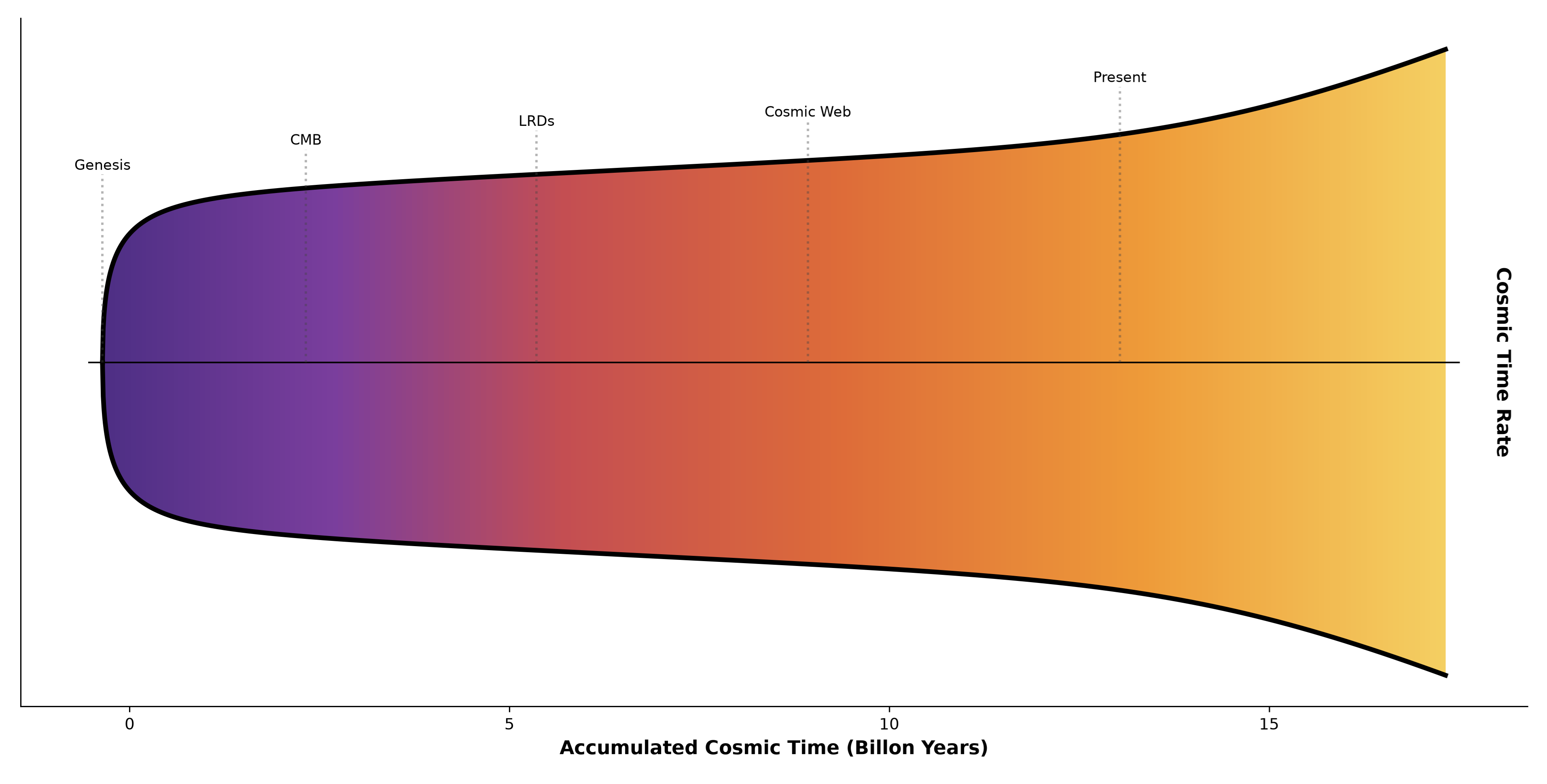
At Genesis, the Cosmic Time Rate is strongly suppressed.
As suppression relaxes, the Cosmic Time Rate increases rapidly.
During the era of strongest Gravitational Advantage, this increase becomes increasingly moderated.
The acceleration of the Cosmic Time Rate increases once more as expanding voids come to dominate the geometry of the universe.
The Cosmic Time Rate continues to increase into the future, tending ever closer towards the Unsuppressed Time Rate.
Viewed from this alternative reference frame, the apparent explosive beginning of the universe and the apparent acceleration of the modern universe are revealed as related consequences of the same underlying process. Both emerge naturally from the changing Cosmic Time Rate associated with the evolving balance between expansion and suppression. The universe's apparent beginning and apparent late time acceleration therefore represent opposite ends of the same continuous evolutionary curve.
5 Alternative Modelling Interpretation: Direct vs Indirect Time Coupling
EDR's third axiom links time directly to expansion. This idea can be interpreted in two different ways, both of which produce the same observable physics:
-
Direct Time Coupling Interpretation. This is the interpretation developed throughout this paper. The local expansion rate determines the Proper Time Rate. Time is the directly realised pace of local expansion, and the universe unfolds through a genuine process of continual change. Horizons, early time behaviour, and the arrow of time follow naturally from this direct coupling.
-
Indirect Time Coupling Interpretation. The same axioms also allow a more traditional spacetime interpretation. This interpretation aligns with any framework that employs the General Relativity (GR) mathematical ontology [1] - including ΛCDM, relativistic MOND-like models, emergent-gravity approaches, TeVeS-style formulations, and other metric-based theories.
In this view, expansion behaviour shapes an emergent spacetime geometry, and time is treated as a coordinate within that geometry. The physical behaviour of the universe is unchanged: suppression near mass, gradients, large-scale evolution, and all observable consequences remain identical. The interpretation differs, but the physics does not.
5.1 Interpretational, not physical, difference
Both interpretations originate from the same axioms and describe the same universe. The distinction is purely one of ontological preference: whether time is taken to be directly coupled to expansion, or indirectly coupled through emergent spacetime geometry. Because both interpretations make the same predictions, choosing between them becomes a matter of choosing which description provides the clearest physical picture.
The Direct Time Coupling interpretation is used in this paper because it provides a clearer physical account of horizons, early time behaviour, and the arrow of time. However, this is an ontological preference only - readers who prefer a GR-style spacetime ontology can adopt the Indirect Time Coupling interpretation without altering any physical predictions.
In the Direct interpretation, Expansion Gradients define a non-Euclidean three-dimensional geometry of space, with time arising as the realised physical rate of expansion rather than as a coordinate. In the Indirect interpretation, the same underlying behaviour is represented within a four-dimensional GR spacetime manifold, where time is treated as a coordinate and curvature encodes the effects of Expansion Suppression. The two interpretations therefore differ only in ontology, while being intended to describe the same physical processes - 3D evolving spatial geometry with an external time parameter versus 4D spacetime geometry with time as a dimension.
In the Indirect interpretation, time remains part of the spacetime geometry, which naturally leads to the familiar block-universe picture. In the Direct interpretation, time reflects the ongoing process of expansion, so the universe is viewed as continually evolving rather than already complete. This ontological distinction also explains their differing treatments of singularities: in the Direct interpretation, collapse cannot complete in finite realised time because the Proper Time Rate slows with increasing suppression, whereas the Indirect interpretation retains the singular structures implied by GR’s manifold-based formulation.
5.2 Interpretational Differences in Extreme Regimes
Although both interpretations produce identical physical behaviour in all observable regimes, they diverge conceptually in situations where the GR mathematical ontology introduces known singular structures. These differences arise not from new physics but from the interpretational consequences of EDR’s third axiom.
This difference reflects the broader ontological split between the two interpretations: the Indirect interpretation inherits GR’s block-universe spacetime, in which singularities appear as features of a fixed four-dimensional manifold, whereas the Direct interpretation describes an evolving universe in which time slows with increasing suppression, preventing GR-style singularities from forming in finite realised time.
-
Black Holes under Direct vs Indirect Time Coupling. In the Direct Time Coupling interpretation, extreme suppression of expansion slows the Proper Time Rate toward zero, preventing collapse from completing in finite realised time. The interior becomes a region of extremely slow evolution rather than a true singularity.
In the Indirect Time Coupling interpretation, any model that inherits the GR global structure retains the mathematical singularity implied by the spacetime manifold.
-
Early Time / Big Bang Behaviour. In the Direct Time Coupling interpretation, the apparent beginning reflects the slow-to-fast transition of the expansion-defined time rate: the universe accelerates out of an effectively timeless state.
In the Indirect Time Coupling interpretation, any GR-ontology-based model recovers the familiar coordinate time singularity, as time is treated as a coordinate within an emergent spacetime geometry.
6 Target Boundary Conditions for Mathematical Modelling
This paper deliberately avoids committing to any specific mathematical formalism for EDR. EDR does not require any particular mathematical implementation. The underlying mechanism could be expressed through a scalar equation, a tensor-based formulation, or a completely different mathematical approach. In principle, the gravitational constant in GR [1] could be replaced with a more elaborate expression that incorporates the Outward Expansion Pressure EDR predicts, but doing so would add further complexity to GR’s already intricate machinery. By contrast, a formulation built directly around expansion - whether through a field-like equation or a reframed treatment of spacetime - may offer a far simpler route. In EDR, expansion is not treated as the motion of space through an external background or medium, but as the local emergence of new spatial substrate itself.
The purpose of this section is therefore not to prescribe the mathematics, but to define the physical outputs that any valid EDR formulation must reproduce. The following conditions set out the physical behaviour that any such formulation must be able to deliver, regardless of the mathematical route it takes.
6.1 Gravitation as a Mixture of Attraction and Repulsion
Any valid formulation of EDR must reproduce GR equivalent [1] gravitational behaviour in the weak-suppression limit, where expansion is only slightly reduced by mass-energy. At the same time, it must naturally include a repulsive component that emerges as suppression falls. This repulsive behaviour is not a separate force. It arises naturally as expansion returns towards its unsuppressed state in low-density regions. As mass-energy density decreases, the attractive contribution weakens while the repulsive contribution strengthens, reaching a peak steady state in the deepest cosmic voids. Measured galaxy rotation curves and sizes provide a potential means of bounding this effect.
6.2 Effective Constants and the Masking of Expansion Pressure
Any mathematical formulation of EDR must account for the fact that the gravitational constant used in practice is not a fundamental parameter but an effective one. Because measurements of \(G\) and \(GM\) are derived from orbital motion, any Outward Expansion Pressure would already be folded into the measured values.
A valid EDR formulation must therefore reproduce the observed value of \(G\) as the equilibrium result of two opposing influences: the attractive effect of suppressed expansion near mass, and the outward pressure associated with unsuppressed expansion in the surrounding region. In regions where these two components fall off together, the effective constant remains stable and GR equivalent. In regions where the balance is disturbed - such as across large-scale galactic gradients - the effective constant must shift in a way that produces the small, directional accelerations observed in high-precision astrometric data.
This requirement ensures that any mathematical model of EDR captures both the local masking behaviour that makes GR so successful in bound systems, and the subtle departures that arise when the system is exposed to asymmetric expansion environments.
6.3 The Unitary Metric Condition
Time and distance must remain tied to the same underlying expansion process. Clocks and rulers must therefore change together, recovering correct light-bending and time-delay behaviour. This ensures that the familiar geometric relationships between time, distance, and motion arise naturally from expansion.
6.4 The Local Gradient Condition
The spatial distribution of expansion must vary inversely with mass-energy density. Mass acts as a local sink for expansion, creating smooth gradients in the local expansion rate that reproduce the inverse-square law of gravity. Expansion must approach a stable background value in low-density voids. These gradients are treated as continuous local variations in Realised Spatial Extent rather than discontinuities between separate spatial regions. In the weak-suppression limit, small perturbations must reproduce Newtonian predictions.
6.5 Causality and Local Convergence Conditions
Changes in expansion must propagate at the finite cosmic speed limit [8]. The equations cannot permit instantaneous action-at-a-distance. In weak-suppression regimes, the model must converge smoothly with established calculations, accurately reproducing:
Mercury’s perihelion shift
Gravitational redshift [5]
Light bending
Shapiro delay [6]
GPS-level time dilation [7]
6.6 Cosmic Microwave Background (CMB)
Changes predicted by EDR, such as redshift and void lensing alterations, must not contradict existing highly precise measurements of the CMB [3].
6.7 Geometric Continuity and Non-Etheric Behaviour
Any valid formulation of EDR must treat Realised Spatial Extent as part of the evolving geometric state of the universe. Regions that have experienced different expansion histories must retain those differences as part of their realised geometry rather than requiring continual recreation from local conditions alone.
Changes in expansion and suppression must propagate causally at the finite cosmic speed limit. As mass-energy distributions evolve, the geometry must evolve continuously in response, preserving historical continuity without the need for a preferred background frame or ether-like structure.
7 Candidate Mathematical Framework
Note: The following derivation is not presented as a finished theory, nor as the only possible mathematical formalisation of Expansion Defined Relativity. EDR is first and foremost a conceptual framework describing how time, gravitation, and cosmic evolution emerge from differential expansion.
The purpose of this section is therefore not to replace the mathematical machinery of General Relativity, but to illustrate one possible route through which EDR's underlying physical principles might be expressed mathematically. The equations presented below should be regarded as a candidate physical field description rather than a complete gravitational theory.
Future mathematical development may take several forms. The expansion field described here could remain a standalone scalar formulation, be incorporated into more sophisticated tensor-based approaches, or potentially contribute additional source terms within an extended General Relativity framework. In such a formulation, the expansion field would not replace spacetime geometry, but provide a physical mechanism through which that geometry emerges and evolves.
The equations that follow are therefore intended as a starting point for future formalisation rather than a final mathematical implementation. Their purpose is to demonstrate that the core principles of EDR can be expressed in a mathematically consistent form, while defining a possible bridge between EDR's physical ontology and the geometric language of General Relativity.
7.1 The Expansion Field
Unlike conventional scalar-tensor theories, which typically introduce scalar fields as modifications to an existing gravitational framework, this derivation treats the local expansion state as a candidate physical field describing the degree of Expansion Suppression present within a region of space.
The central quantity, denoted by \(\varphi\), represents the realised local expansion rate: the physical rate at which new spatial substrate is generated. Because expansion and time rate are inseparable in EDR, the Proper Time Rate is directly proportional to \(\varphi\).
Variations in this field arise in response to local mass-energy density. Regions of higher density suppress the field, while less dense regions allow it to approach its natural unsuppressed state. Spatial gradients in the field therefore produce the differential expansion behaviour from which EDR derives gravitational effects.
Within this interpretation, gravity is not treated as a fundamental interaction in its own right, but as the observable consequence of expansion-field gradients and the accompanying differences in Proper Time Rate and Realised Spatial Extent. The field therefore provides a candidate physical mechanism underlying the curvature-like behaviour that General Relativity successfully describes geometrically.
7.2 The Master Equation
The master equation is:
\[ \ddot{\varphi} - \nabla^{2}\varphi + \lambda(\varphi - S) = -\beta(\rho_m - 3p_m) \]
Where:
\(\lambda\) is the constant defining the restoring strength of the expansion field, and controls how quickly suppressed regions recover and how far expansion-suppression effects extend.
\(S\) is the constant defining the natural expansion rate that space settles into in the absence of any mass-energy to interfere with it.
\(\beta\) is the coupling constant, defining the strength of the interaction between matter and the expansion field.
\(\varphi\) is the expansion field value (the local state of expansion).
\(\ddot{\varphi}\) is the acceleration of the expansion field's evolution over time.
\(\nabla^{2}\varphi\) is the spatial gradient, measuring how the expansion rate changes from one point in space to another.
\(\lambda(\varphi-S)\) is the restoring force, representing the field’s physical tendency to relax toward its natural state (\(S\)).
\(\rho_m - 3p_m\) is the source terms, where \(\rho_m\) is the density of matter-energy and \(p_m\) is its internal pressure, which together act to suppress the field.
7.3 Emergence of the Sink Behaviour
In EDR, an ad hoc sink equation is not required. The sink behaviour - the tendency of matter to aggregate - is proposed to emerge naturally from the response of the expansion field to local mass-energy density:
-
Mechanism: Where mass-energy density (\(\rho_m\)) is high, the source term on the right becomes large and negative, causing the local expansion rate \(\varphi\) to drop below its natural background level (\(S\)).
-
The Sink: Where expansion is suppressed, the resulting expansion gradients drive differences in the evolution of Realised Spatial Extent. Together with the associated differences in Proper Time Rate, these differences in Realised Spatial Extent and Proper Time Rate establish the emergent geometry of EDR. Matter responds to this geometry, producing the gravitational behaviour conventionally described through spacetime curvature. In this interpretation, the sink is not a separate force or a direct flow down an expansion gradient, but an emergent consequence of the spatial and temporal geometry produced by differential expansion.
The precise mathematical relationship between Expansion Suppression, the evolution of Realised Spatial Extent and the associated Proper Time Rate differences remains to be formally established. A complete mathematical formulation must demonstrate how the proposed emergent geometry reproduces the spacetime relationships and geodesic behaviour described by General Relativity in the appropriate limits.
7.4 From Newtonian Behaviour to GR-like Dynamics
In weak-suppression environments \(\varphi = \varphi_0 + \delta\varphi\), where \(\varphi_0\) is the background expansion rate and \(\delta\varphi\) is a small local deviation caused by mass-energy. The following limits provide starting points for investigating how established gravitational behaviour might emerge from the EDR expansion field:
-
The Newtonian Limit (The Poisson Link). In the weak-field, static limit, the time-dependent term (\(\ddot{\varphi}\)) vanishes. The Master Equation simplifies to:
\[ -\nabla^2 \varphi \approx -\beta\rho_m \]
In the weak-field limit, identifying perturbations in \(\varphi\) with the Newtonian potential \(\Phi\), this becomes:
\[ \nabla^2 \Phi = 4\pi G\rho_m \]
If perturbations in the expansion field can be shown to be proportional to the Newtonian gravitational potential, with the appropriate dimensional normalisation, this relationship offers a possible route to recovering Newtonian gravitational behaviour. The proportionality and coupling constants would need to be established by the mathematical formulation; the correspondence is therefore a proposed limit to be investigated rather than a demonstrated identity.
-
The GR Connection (The Dynamic Limit). In time-dependent environments, the expansion field is no longer static, and its evolution is governed by the full dynamic Master Equation. Its wave-like structure, together with its coupling to the matter-energy source term, provides a possible starting point for investigating the relationship between EDR and relativistic gravitational dynamics.
A more complete treatment would need to establish how perturbations in the expansion field generate the effective spacetime geometry, and demonstrate whether the resulting metric and equations of motion recover the tested predictions of General Relativity. In particular, the propagation of field disturbances at the cosmic speed limit and the relationship between the expansion field and the stress-energy tensor would need to be derived explicitly.
The candidate equation therefore suggests a possible mathematical pathway towards GR-like behaviour, but does not yet constitute a derivation of General Relativity or demonstrate its full recovery.
7.5 The Indirect Interpretation: Integration of the Expansion Field (Conceptual Specification)
The following requirements outline the conceptual conditions necessary for integrating the Expansion-Defined Relativity (EDR) field into the Einstein Field Equations. This section provides a roadmap for transitioning from the current conceptual framework to a future formal mathematical model. No derivations are attempted here; instead, the focus is on the physical and logical criteria that must be satisfied for full compatibility with General Relativity (GR).
-
Defining the Field’s Physical Role. The expansion field must be expressible in terms that GR recognises as physically meaningful sources of curvature. This requires that its energy-related behaviour - including how it stores and transfers expansion-driven effects - can be interpreted in the same conceptual category as matter and energy in GR.
-
Temporal and Coordinate Consistency. Because the expansion field evolves according to an intrinsic temporal dynamic, its internal time parameter must be made compatible with the spacetime coordinates used in GR. This ensures that the field behaves consistently for all observers and can be meaningfully embedded within the relativistic framework.
-
Integration into the Gravitational Framework. Once the field’s physical role and temporal behaviour are conceptually aligned with GR, it must be incorporated into the gravitational framework as a genuine contributor to curvature. In this integrated picture, cosmic expansion no longer appears as an externally imposed cosmological constant (Λ), but emerges naturally from the dynamics of the expansion field itself.
While this specification outlines the necessary logical and physical requirements for integration, the formal mathematical derivation is reserved for future work. By meeting these requirements, the expansion field will function as an integral component within the gravitational metric, allowing EDR dynamics to be recognised as the physical mechanism generating the curvature observed in General Relativity.
7.6 Illustrative Scaling of Gravitational Advantage
The purpose of this subsection is not to derive Gravitational Advantage from first principles, but to provide an illustrative indication of how the conditions supporting gravitational organisation may have varied throughout cosmic history.
As discussed previously, Gravitational Advantage arises from three related effects:
Stronger suppression environments increase the relative significance of local perturbations.
Smaller characteristic void scales produce steeper Expansion Gradients.
Higher density environments place matter in closer proximity.
A simple illustrative scaling may therefore be written as:
\[ GA \propto F_sF_c \]
where:
\(F_s\) represents the relative significance of local suppression;
\(F_c\) represents geometric compactness.
To first order, average cosmic density evolves as:
\[ \rho \propto (1+z)^3 \]
where \(z\) is cosmological redshift.
Since EDR proposes that local perturbations become increasingly significant within denser suppression environments, a first-order approximation gives:
\[ F_s \propto (1+z)^3 \]
The compactness contribution arises from the characteristic scale of void structures. If void scale broadly tracks cosmic scale:
\[ L_v \propto a \]
where \(a\) is the cosmological scale factor,
\[ a=\frac{1}{1+z} \]
then:
\[ F_c \propto \frac{1}{L_v} \propto (1+z) \]
Combining the two contributions gives:
\[ GA \propto (1+z)^4 \]
This expression is intended solely as an illustration of the qualitative dependencies present within EDR. It is not a derived equation and should not be interpreted as a quantitative prediction.
Nevertheless, it illustrates an important feature of the framework: the dense, compact environments of the early universe would naturally have provided conditions that were dramatically more favourable to gravitational organisation than those present today.
Using present-day conditions as a normalised reference:
\[ GA_{rel}(z) \approx (1+z)^4 \]
gives:
| Epoch | z | Illustrative Relative GA |
|---|---|---|
| Today | 0 | 1 |
| Cosmic Web Formation | 2 | 81 |
| LRD Epoch | 8 | 6,561 |
| Reionisation | 20 | 194,481 |
These values should not be interpreted as increases in gravitational strength. Rather, they provide a rough indication of how favourable the surrounding environment may have been for gravitational organisation within the EDR framework.
8 Falsifiable Predictions
EDR makes several concrete observationally testable predictions that follow directly from its core principles. These predictions therefore offer clear opportunities for empirical validation.
Several of these predictions can be tested directly through meta-analysis of existing datasets, while others point to longer-term observational programmes.
8.1 Little Red Dots and Morphological Signatures
EDR predicts that the extreme Expansion Gradients present during the Little Red Dot epoch should produce observable signatures that offer a different interpretation from conventional merger-driven explanations. Because these gradients operate across compact, rapidly evolving structures, photons originating from different regions of the same object experience different degrees of gravitational redshift before reaching the observer. The resulting differences in observed wavelength and relative brightness may alter the apparent contribution of individual regions to the observed UV morphology. EDR therefore predicts a number of specific observational signatures that can be tested using existing JWST datasets.
8.1.1 Predicted Signatures
EDR predicts that Little Red Dots should not necessarily represent multiple intrinsically distinct classes of object. Instead, a common underlying structure may produce a range of observed appearances.
The unusually dense environments present during the Little Red Dot epoch are proposed by EDR to have generated compact systems containing exceptionally deep gravitational wells and rapidly growing massive central black holes. The resulting Expansion Suppression is predicted to be greatest within the central regions of these systems, producing extremely low local Proper Time Rates and correspondingly large gravitational redshifts.
EDR therefore predicts a natural distinction between:
-
a highly redshifted compact central component associated with the deepest region of Expansion Suppression; and
-
a surrounding UV-emitting structure residing within progressively weaker suppression environments.
The consequence would be that photons originating from the central region are expected to experience substantially greater gravitational redshift than those emitted by the surrounding structure. Depending on the magnitude of this differential redshift, emission originating from the compact core may contribute differently to the observed UV signal than emission arising from less strongly suppressed surrounding regions. The apparent UV morphology would therefore reflect not simply the physical distribution of emitting material, but also the differing observational contributions of regions experiencing different degrees of Expansion Suppression.
Because the relative contribution of these components depends on observational geometry and line-of-sight projection, a single underlying physical structure may produce a diverse range of observed morphologies. Objects may appear highly compact, exhibit asymmetric UV emission, display multiple UV-emitting components, or contain substantially extended UV structures.
Importantly, EDR predicts that these appearances are unlikely to occur with equal frequency. If observational geometry influences the relative visibility of the compact central component and surrounding UV-emitting structures, some apparent morphologies should dominate while others occur less frequently. The observed population should therefore exhibit a characteristic non-uniform distribution of appearances rather than a random mixture of unrelated object classes. This prediction does not require a specific intrinsic geometry, only that a common underlying structure presents differently as the relative visibility of its constituent components changes.
8.1.2 Comparison with Current Observations
Recent studies have proposed that the observed diversity of LRD morphologies may arise from viewing-angle effects acting on a common intrinsic structure. In particular, prolate ("cigar-shaped") geometries have been proposed as one possible explanation for why some systems appear compact while others exhibit extended or multiple UV components [17].
EDR arrives at a similar observational expectation through a different physical interpretation. While the prolate-geometry interpretation attributes the diversity primarily to intrinsic elongation and orientation, EDR attributes it to the differing observational contributions of an extremely redshifted compact central region and surrounding UV-emitting structures occupying less strongly suppressed environments. The two interpretations therefore offer different possible physical explanations for some of the same observed morphological diversity.
Recent JWST observations indicate that LRD populations exhibit substantial variation in ultraviolet structure, including compact systems, asymmetric UV morphologies, and systems containing more extended UV emission [16].
Recent studies have also identified specific relationships between morphology and spectral properties. Ando et al. reported an anticorrelation between UV effective radius and Balmer-break strength, alongside correlations between Balmer-break strength and several rest-frame UV spectral characteristics, while Cloonan et al. found that ultraviolet emission is frequently more extended than corresponding optical emission. These studies do not identify differential gravitational redshift as the cause of these relationships, but their findings provide observational characteristics that EDR's proposed core-to-surrounding-structure interpretation may help explain [18], [19].
8.1.3 Falsifiable Prediction
These observations do not uniquely support EDR and alternative explanations remain viable. However, they suggest a clear observational test.
If the EDR interpretation is correct, measurable relationships should exist between:
UV extent;
UV asymmetry;
apparent colour and reddening (including Balmer-break strength);
spectral characteristics;
and the prominence of compact central emission.
The key distinction is whether the observed diversity reflects multiple intrinsically distinct object populations or differing manifestations of a common underlying structure. EDR predicts the latter. Existing studies have already identified correlations between UV size, Balmer-break strength and spectral characteristics within LRD populations [18]. Future high-resolution observations capable of mapping both compact central emission and extended UV structures should therefore reveal systematic relationships linking morphology and spectral properties across the LRD population.
8.2 A Unified Galactic Gradient Signature in Solar System Astrometry
EDR predicts a single galactic-scale acceleration vector, which should leave a consistent signature across multiple independent datasets, including planetary ranging, lunar ranging, and spacecraft flybys. The significance of the prediction is not any one anomaly in isolation, but the expectation that all affected systems should point back to the same underlying direction and acceleration scale.
The Solar System's ~60° tilt relative to the Milky Way's disc, combined with its position ~20–30 light years above the galactic mid-plane, creates a persistent background acceleration vector oriented perpendicular to the ecliptic. This arises from the asymmetric Expansion Gradient between the dense galactic interior and the low-density intergalactic medium.
The presence of this predicted asymmetry can be tested through a meta-analysis of existing Lunar Laser Ranging (LLR), planetary radar ranging, and flyby Doppler datasets, without requiring new observations. To the author's knowledge, the identification of these anomalies as a unified galactic gradient signature, with a consistent predicted direction and physical mechanism, has not previously appeared in published literature.
8.2.1 Manifestations of a Common Galactic Acceleration Vector
The internal masking loop ensures that local measurements of \(G\) and \(GM\) absorb the Outward Expansion Pressure. However, when the Solar System is exposed to an external gradient, this balance is perturbed. EDR predicts a consistent, direction-dependent drift in orbital elements arising from exposure to an external Expansion Gradient.
Testable signatures:
-
Long-baseline astrometric datasets - including Lunar Laser Ranging (LLR) and planetary radar ranging - should reveal a consistent, direction-dependent drift in orbital elements aligned with the galactic gradient direction.
A small, steady increase in the astronomical unit has been measured at [10]:
\[ \dot{a} = 15 \pm 4\,m\,cy^{-1} \]
Similarly, the Moon's orbital eccentricity shows a secular increase of [11]:
\[ \dot{e}=(5\pm2)\times10^{-12}yr^{-1} \]
Within EDR, these may represent manifestations of a common underlying acceleration vector. Both are expected manifestations of the same background acceleration vector produced by the galactic gradient predicted by EDR.
8.2.2 Flyby Anomalies as a Function of Trajectory Orientation
EDR predicts that spacecraft passing through Earth’s gravitational well will experience small, trajectory-dependent residuals depending on whether their inbound and outbound paths align with or cut across the galactic Expansion Gradient.
Testable signature:
-
Future Earth flybys with carefully controlled approach vectors should reproduce the pattern already seen in historical data:
Such directional flyby behaviour would be difficult to explain naturally without an acceleration vector such as that predicted by EDR [13].
8.2.3 Consistency with Iorio's Hubble-Scale Acceleration
In 2011, Lorenzo Iorio demonstrated that both anomalies could be simultaneously satisfied by a single unexplained background acceleration vector scaled to the Hubble parameter [14]. Rather than treating this acceleration as an unexplained empirical parameter, EDR identifies the galactic Expansion Gradient as its physical origin.
Testable signature:
-
The magnitude and direction of the inferred acceleration from AU drift and lunar eccentricity growth should match each other and align with the predicted galactic gradient direction.
8.3 Rotation-Curve Asymmetries Correlated with Void Proximity
EDR predicts that galaxies adjacent to large cosmic voids experience stronger Expansion Gradients at their outer boundaries than morphologically similar galaxies embedded in denser environments. Because the proposed EDR contribution to galactic rotation arises from void-driven geometry rather than unseen matter, the magnitude of the effect should correlate with void proximity and void depth.
Testable signature:
-
Galaxies positioned adjacent to deep voids should exhibit systematically higher outer rotation velocities than otherwise comparable galaxies situated in denser environments [12].
-
Rotation-curve asymmetries should preferentially occur when one side of a galaxy faces a substantially deeper void environment than the opposite side.
-
The magnitude of these asymmetries should scale with local void geometry rather than inferred dark matter halo properties.
Existing and future surveys capable of combining rotation-curve measurements with large-scale void catalogues provide a direct test of this prediction.
8.4 Evidence of Galactic Mass Shedding Since Early-Time Formation
The galactic evolutionary model predicted by EDR offers a number of simple, falsifiable predictions:
Testable signatures:
-
Dwarf galaxies formed from shed material should show no evidence of central black holes and should preferentially lie in coherent spatial or orbital structures around their parent systems.
-
Coherent stellar streams and gas clouds should be observable around many galaxies, preferentially aligned in orbital planes relative to their parent systems.
-
Deep-field surveys should reveal the progressive imprint of mass shedding across successive epochs of Cosmic Time.
Preliminary evidence for these behaviours already exists, but systematic quantification and correlation with EDR’s predictions remain essential for validation.
8.5 Void-Driven Cosmic Acceleration
EDR predicts that cosmic acceleration is a real physical effect driven by the expansion of deep voids, amplified by differential time rates.
Testable signatures:
-
The apparent acceleration should correlate with void distribution and depth. Large-scale surveys such as DESI, Euclid, and LSST should detect anisotropies in the Hubble flow aligned with major void structures.
8.6 Clock-Rate Differences Between Voids and Galaxies
Because expansion and time rate are the same physical process in EDR, clocks in low-density voids should tick faster than clocks in galaxies.
Testable signatures:
-
Precision timing of astrophysical clocks - pulsars, FRBs, and quasars - should reveal a small but measurable environmental dependence in frequency stability or redshift drift when comparing sources in voids versus sources in clusters.
9 Plain-English Summary
Imagine the universe as a foam of regions that age at different rates. The bubbles are cosmic voids; the membranes are where matter collects and galaxies are found.
The central idea of EDR is that expansion does not happen in time - it creates time. Regions with more mass-energy suppress this generative process, causing their internal clocks to run more slowly, while emptier regions evolve more quickly. The familiar geometric behaviour of gravity is not assumed but emerges from how expansion is locally suppressed around matter.
When we observe these different regions from our own vantage point, we interpret them through our local time rate, which creates several "apparent" effects:
Apparent Acceleration: Because voids evolve on faster-running clocks, their expansion appears to us to be accelerating. In EDR, this is a real physical process driven by void growth, amplified by the time rate contrast.
Apparent Missing Mass: Outward Expansion Gradients near the edges of galaxies naturally boost orbital velocities, removing the need for additional unseen mass.
Apparent Early Time Behaviour: In the dense, early universe, strong Expansion Suppression compressed the entire evolutionary history. To our faster-running clocks, this creates the appearance of a "sudden beginning," even if the underlying process is fundamentally eternal.
Large-scale structure grows from this expansion pushing matter aside, rather than from matter pulling itself together through gravity alone. Because cosmic behaviour follows from the interaction of expansion and suppression, the universe can appear young from the inside even if its underlying evolution is potentially eternal from the outside.
EDR shows how a hot, dense early phase, rapid structure formation, and today’s large-scale patterns can all arise naturally from differential expansion. In the dense early universe, a regime of extreme Gravitational Advantage made structure formation exceptionally efficient, helping explain the rapid emergence of galaxies and black holes. It explains why gravity behaves exactly like General Relativity in testable regimes like the Solar System, while adding an Outward Expansion Pressure that becomes visible only across large-scale gradients which shape the wider cosmos. By tying time itself to the physical generation of space, EDR turns many of the universe’s longstanding cosmological tensions into natural consequences of the framework.
10 Glossary of Terms
Cosmic Time Rate: The universe-wide rate at which time progresses during a particular cosmological epoch. In EDR, the Cosmic Time Rate evolves alongside the overall state of cosmic expansion and provides a description of how rapidly the universe is evolving at any stage of its history.
Differential Expansion: Differences in local expansion rate between neighbouring regions of space. In EDR, these gradients produce the effects associated with gravitation.
Differentiation Potential: A conceptual measure of the effectiveness with which Gravitational Advantage can generate and amplify structural differentiation. Differentiation Potential depends upon both the degree of existing differentiation and the prevailing Gravitational Advantage and is greatest when both are simultaneously significant.
Direct Time Coupling: A conceptual interpretation of EDR in which the local rate of spatial expansion is identified as the fundamental physical process generating the local rate of time. In this view, time is a directly realised process of physical evolution, rather than an emergent coordinate within a pre-existing geometry.
EDR (Expansion Defined Relativity): The proposed physical framework in which time, gravitation, and large-scale cosmic behaviour emerge from variations in spatial expansion and its suppression by mass-energy.
Effective Gravitational Constant: Within the EDR interpretation, the observed gravitational constant behaves as an effective equilibrium parameter reflecting both attractive Expansion Suppression near mass and outward pressure associated with unsuppressed expansion.
Expansion: In EDR, expansion is the continual generation of spatial substrate. Realised Spatial Extent is the accumulated consequence of that process.
Expansion Gradient: A variation in the local expansion rate between neighbouring regions. In EDR, Expansion Gradients are the fundamental driver of gravitational behaviour, cosmic structure formation, void growth, galactic dynamics, and time rate differences between regions.
Expansion Suppression: The local reduction of expansion caused by mass-energy. In EDR, Expansion Suppression produces slower Proper Time Rates, reduced spatial extent, and the gradients associated with gravitation.
Gradient: A smooth spatial difference in local expansion rate between neighbouring regions. In EDR, gravitational effects emerge from such gradients.
Gravitational Advantage: The increase in the effectiveness of emergent gravity that occurs in high-density environments, caused by enhanced fractional Expansion Gradients, short matter separations, and proto-void driven matter concentration.
General Relativity (GR): Einstein’s theory describing gravitation as the behaviour of spacetime geometry in the presence of mass-energy.
Indirect Time Coupling: A conceptual interpretation of EDR compatible with General Relativity’s geometric ontology. In this view, spatial expansion behaviour generates an emergent spacetime geometry, within which time is treated as a coordinate. While the underlying physical expansion-gradients remain identical to the Direct interpretation, this view frames the resulting universe through the lens of a metric-based spacetime manifold.
Length Deficit: An emergent relational property arising from the comparison of regions whose Realised Spatial Extents differ as a consequence of differing expansion histories.
Local Expansion Rate: The realised local condition of expansion within a region of space, determining the local rate of time and Realised Spatial Extent.
Mass-Energy: The combined physical quantity associated with matter, radiation, and energy. In EDR, mass-energy locally suppresses expansion.
Monotonic Expansion: Expansion that proceeds continuously in one direction over Cosmic Time without global reversal.
Outward Expansion Pressure: A repulsive component associated with unsuppressed expansion. In EDR, this pressure is weakest in dense regions where expansion is heavily suppressed and strongest in low-density regions where expansion is freer. Within bound systems it is normally masked inside inferred values of mass and the gravitational constant.
Proper Time: The locally experienced passage of time measured by physical clocks. In EDR, Proper Time is determined directly by the local expansion rate. In EDR, Proper Time is the quantity that accrues as a consequence of the Proper Time Rate. Two regions may accumulate different amounts of Proper Time if their Proper Time Rates differ.
Proper Time Rate: The locally realised rate at which time progresses within a specific region of the universe. In EDR, the Proper Time Rate is determined by the local expansion rate and governs how quickly physical processes occur for observers within that environment. Regions experiencing stronger Expansion Suppression have lower Proper Time Rates than regions where expansion is less suppressed.
Realised Spatial Extent: The physically realised separation associated with a region of space. Realised Spatial Extent encodes the local expansion history and forms part of the evolving geometric state of the universe. Regions experiencing greater long-term expansion realise greater spatial extent, while regions subject to sustained Expansion Suppression realise less.
Spatial Substrate: The underlying spatial structure whose continual generation constitutes expansion in EDR. The term does not imply a material medium or ether, but refers to the realised physical structure associated with spatial extent.
Suppression: The reduction of local expansion caused by the presence of mass-energy. In EDR, suppression slows the Proper Time Rate, reduces Realised Spatial Extent, and generates the gradients responsible for gravitational behaviour.
Time Rate: The local rate at which physical processes evolve. In EDR, the time rate is set directly by the local expansion rate: regions with more strongly suppressed expansion accumulate less elapsed Proper Time than regions where expansion is less suppressed.
Unitary Metric: The principle that time rate and Realised Spatial Extent remain coupled through the same underlying expansion dynamics, ensuring that clocks and spatial measurements scale consistently.
Unsuppressed Time Rate: The theoretical maximum time rate corresponding to a reference frame completely free from mass-energy suppression. In EDR, it serves as the external reference against which Cosmic Time Rate and Proper Time Rate are compared.
Void: A large-scale low-density region of the universe in which Expansion Suppression is weak and expansion approaches its background state.
Weak Suppression Limit: The regime in which Expansion Suppression is small enough that EDR converges closely with Newtonian gravity and the weak-field predictions of General Relativity.
11 References
- Einstein, A. (1916). The Foundation of the General Theory of Relativity. Annalen der Physik, 49, 769–822.
- Hubble, E. (1929). A Relation Between Distance and Radial Velocity Among Extra-Galactic Nebulae. Proceedings of the National Academy of Sciences, 15(3), 168–173.
- Planck Collaboration. (2020). Planck 2018 Results. VI. Cosmological Parameters. Astronomy & Astrophysics, 641, A6.
- Dyson, F. W., Eddington, A. S., & Davidson, C. (1920). A Determination of the Deflection of Light by the Sun's Gravitational Field, from Observations Made at the Total Eclipse of May 29, 1919. Philosophical Transactions of the Royal Society A, 220, 291–333.
- Pound, R. V., & Rebka, G. A. (1960). Apparent Weight of Photons. Physical Review Letters, 4(7), 337–341.
- Shapiro, I. I. (1964). Fourth Test of General Relativity. Physical Review Letters, 13(26), 789–791.
- Will, C. M. (2014). The Confrontation Between General Relativity and Experiment. Living Reviews in Relativity, 17(1), 4.
- Bertotti, B., Iess, L., & Tortora, P. (2003). A Test of General Relativity Using Radio Links with the Cassini Spacecraft. Nature, 425, 374–376.
- Williams, J. G., Turyshev, S. G., & Boggs, D. H. (2004). Progress in Lunar Laser Ranging Tests of Relativistic Gravity. Physical Review Letters, 93, 261101.
- Krasinsky, G. A., & Brumberg, V. A. (2004). Secular Increase of the Astronomical Unit from Analysis of the Major Planet Motions, and its Interpretation. Celestial Mechanics and Dynamical Astronomy, 90, 267–288.
- Williams, J. G., & Boggs, D. H. (2009). Lunar Tidal Acceleration and the Lunar Eccentricity Anomaly. Proceedings of the 16th International Workshop on Laser Ranging.
- Tully, R. B., Pomarède, D., Graziani, R., Courtois, H. M., Hoffman, Y., & Dupuy, A. (2019). Cosmicflows-3. Astrophysical Journal, 880, 24.
- Anderson, J. D., Campbell, J. K., Ekelund, J. E., Ellis, J., & Jordan, J. F. (2008). Anomalous Orbital-Energy Changes Observed During Spacecraft Flybys of Earth. Physical Review Letters, 100, 091102.
- Iorio, L. (2011). On the Effects of a Hubble-Scale Acceleration on the Astronomical Unit and the Lunar Orbital Eccentricity. Monthly Notices of the Royal Astronomical Society, 415, 1266–1275.
- D. Nandal et al. (2025). 1000–10,000 Msun Primordial Stars Created the Nitrogen Excess in GS 3073 at z = 5.55. Astrophysical Journal Letters, 995, L12.
- Rinaldi, P. et al. (2025). Not Just a Dot: The Complex UV Morphology and Underlying Properties of Little Red Dots. The Astrophysical Journal, 992(1), Article 71, 71–90. https://doi.org/10.3847/1538-4357/adfa10. arXiv:2411.14383 [astro-ph.GA].
- Peng (2026). A Unified Explanation for JWST Little Red Dots and High-Redshift Low-Mass Disk-like Galaxies: Prolate Galaxies Viewed End-on vs Side-on. arXiv:2603.01668.
- Ando, M., Harikane, Y., Katz, H., Inayoshi, K., & Tanaka, T. S. (2026). The UV Side of Little Red Dots: Red, Compact, and Iron-Enhanced Rest-UV Emission with a Strong Downturn around Lyα. arXiv:2606.03522.
- Cloonan, A. P. et al. (2026). A PANORAMIC of UV-optical morphologies of "Little Red Dots": Two groups of LRDs distinguished by UV half-light radius. The Astrophysical Journal Letters (accepted for publication).
Invitation for Collaboration
This paper sets out the core idea behind Expansion-Defined Relativity (EDR): that the rate of time is coupled with the rate of expansion, and that mass-energy slows both. The aim here isn’t to present a finished theory, but to lay out a clear conceptual foundation that ties together gravity, time, cosmology, and several long-standing anomalies in a single, coherent way.
The next stage is to turn this framework into a full mathematical structure. That will need people with the right background in GR, scalar-field theory, cosmology, or related areas who can see the potential in the underlying idea and want to help shape it into something formal and testable. The candidate master equation takes a mathematically intuitive scalar wave form, making initial exploratory work accessible without the full apparatus of general relativity - a meaningful reduction in the barrier to entry.
If the core principle resonates with you - or if you can see a way to push the maths further - I’d welcome a conversation.
Website:
https://edr.suttle.me.uk
Email:
[email protected]
Copyright Notice
© 2026 David Suttle. All Rights Reserved.
This work is protected internationally under the Berne Convention from the moment of creation. All rights are reserved worldwide. No reproduction, redistribution, modification, adaptation, translation, or creation of derivative works is permitted without the prior written permission of the author.
This conceptual framework is provided solely for reading and personal study. Collaboration enquiries and permission requests are welcome and should be directed to the author.
US Copyright Registration: Pending.